Retrieving specimen

Xenochronos begins from a narrative the studio set itself: a tea table transformed by a parasite that grows into and around its host until the two are one form. When the parasite dies, its body hardens — the table is the relic that remains.
The base is designed through digital modelling and generative growth passes, then 3D printed in parts, assembled by hand, and coated in resin for strength and continuity of surface.
A clear 8 mm glass top sits above the base, keeping the sitting plane legible while the structure below stays deliberately excessive.
The intended finish is a holographic colour-shifting automotive paint, so the surface changes with light and movement; the finish is still in sampling and the entry will be updated when it is fixed.
To be presented at Design Democracy 2026, Hyderabad, this September. The piece moves between architecture and sculpture, and questions how far a functional object can drift from human control before it stops being furniture.
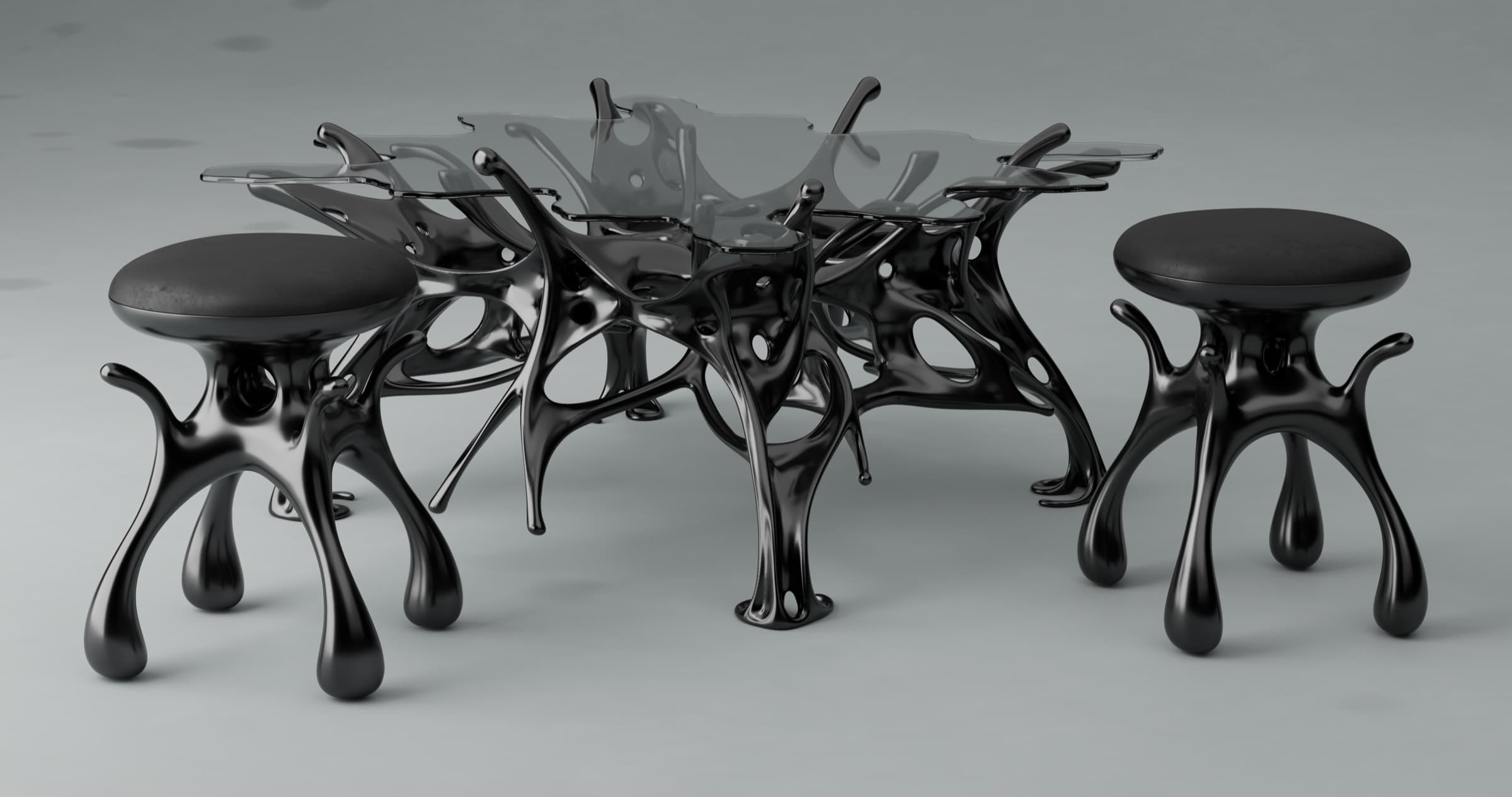
The residual table logic — four stations of legs and a level top plane — still readable inside the growth.
The generative overgrowth that binds the legs into one continuous gloss-black body, printed in parts and unified with resin.
8 mm clear glass, cut to follow the perimeter of the growth rather than a rectangle.
Digital host model subjected to generative growth passes until structure and narrative agree.
Printed in sections, hand-assembled, and resin-coated for strength and a single continuous surface.
Holographic colour-shifting automotive paint proposed; samples in review before the finish is fixed.