Retrieving specimen

Exochronos begins with a single vertebral unit, repeated and slowly deformed along a spine that rises from seat to crest. No two segments are identical; each is resized by the load it carries.
The stack reads as skeletal, but the logic is closer to botany than anatomy — growth by increment, thickening exactly where force accumulates and thinning where it does not.
Cast as sectional pours and welded along concealed seams, the chair is finished until the segment boundaries disappear into one continuous reflective surface.
The mirror polish is structural rather than cosmetic: it forces the eye to read silhouette instead of surface, and the silhouette is where the argument lives.
Sat in, the crest meets the shoulder blades and the stack flexes by fractions of a millimetre — enough to register as alive, not enough to register as movement.
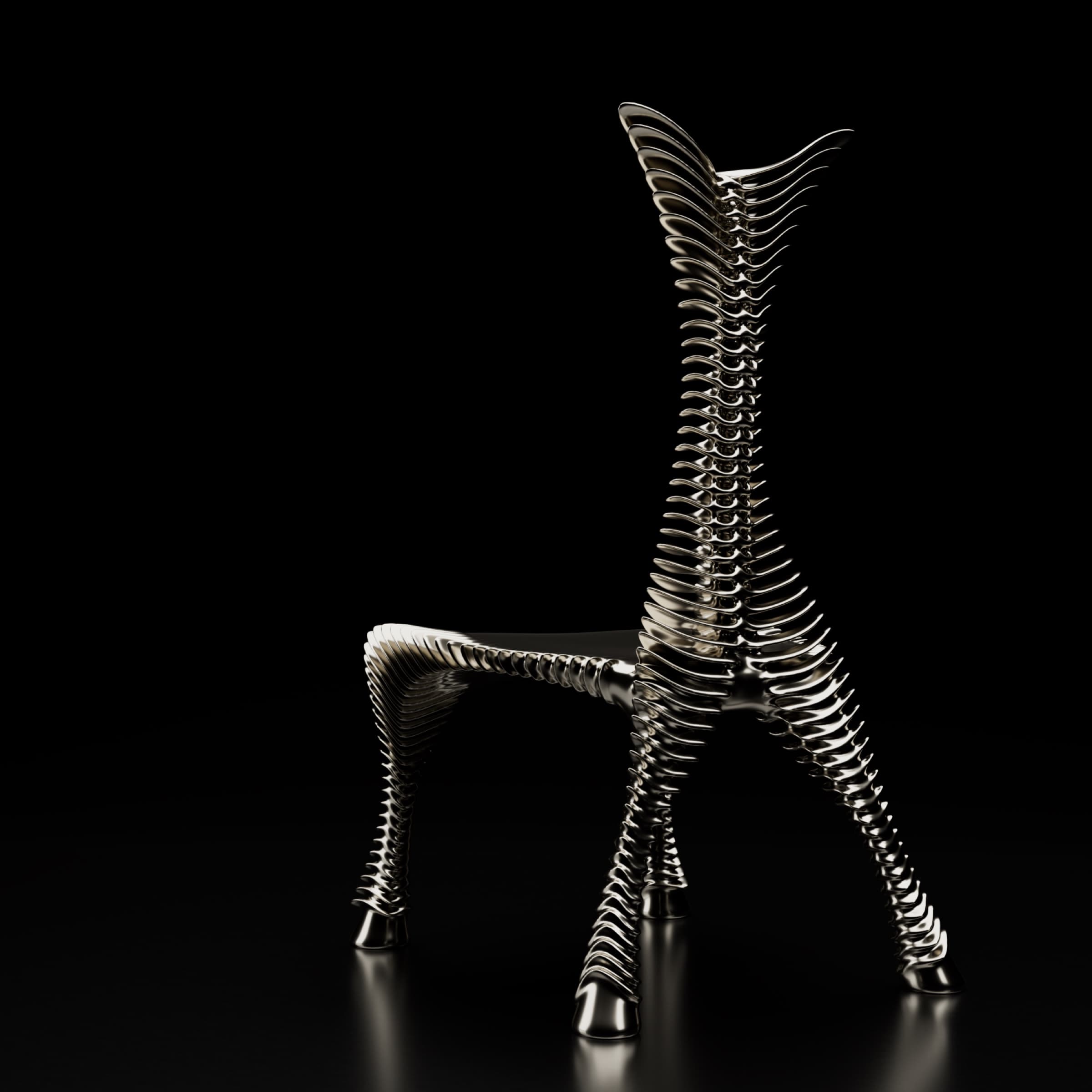
The terminal segments flare into a split crest that receives the shoulders. The flare is the only place the unit is allowed to open; everywhere else it closes around the spine.
Thirty-one segments, each parametrically resized against the bending moment at its station. The visible rhythm of the stack is a direct plot of the load curve.
Four legs splay from the seat plate, tapering through smaller vertebral units to hoof-like feet. The taper follows the same rule as the spine at reduced scale.
Segment geometry solved against seated and reclined load cases; the unit count and taper fixed before any metal is poured.
Sectional investment casting in nickel-silver alloy, five pours, joined along concealed weld lines inside segment shadows.
Ground, then polished through eight grades to a mirror. A brass edition follows the same sequence with a warmer final compound.
Edition of 8. Eight casts per alloy. Nickel-silver and brass editions numbered separately.
Enquire about this specimen