Retrieving specimen

Chronos Chair separates the two duties of a chair — mass and connection — and assigns each to a different material. The oak volumes only bear; the alloy vein only binds.
The blocks are sawn square, charred, and left deliberately mute. Every gesture in the piece belongs to the metal, which pours between the volumes like a liquid caught mid-decision.
The vein was grown in simulation as a single continuous path obliged to visit every block and carry every load case. What looks like flourish is a route map.
Because the vein is one casting, the chair cannot be partially assembled. It exists all at once or not at all — a property the studio regards as the point.
Light is the final component. Under a single directional source the alloy reads as molten and the oak disappears; the chair is designed to be seen the way it was rendered.
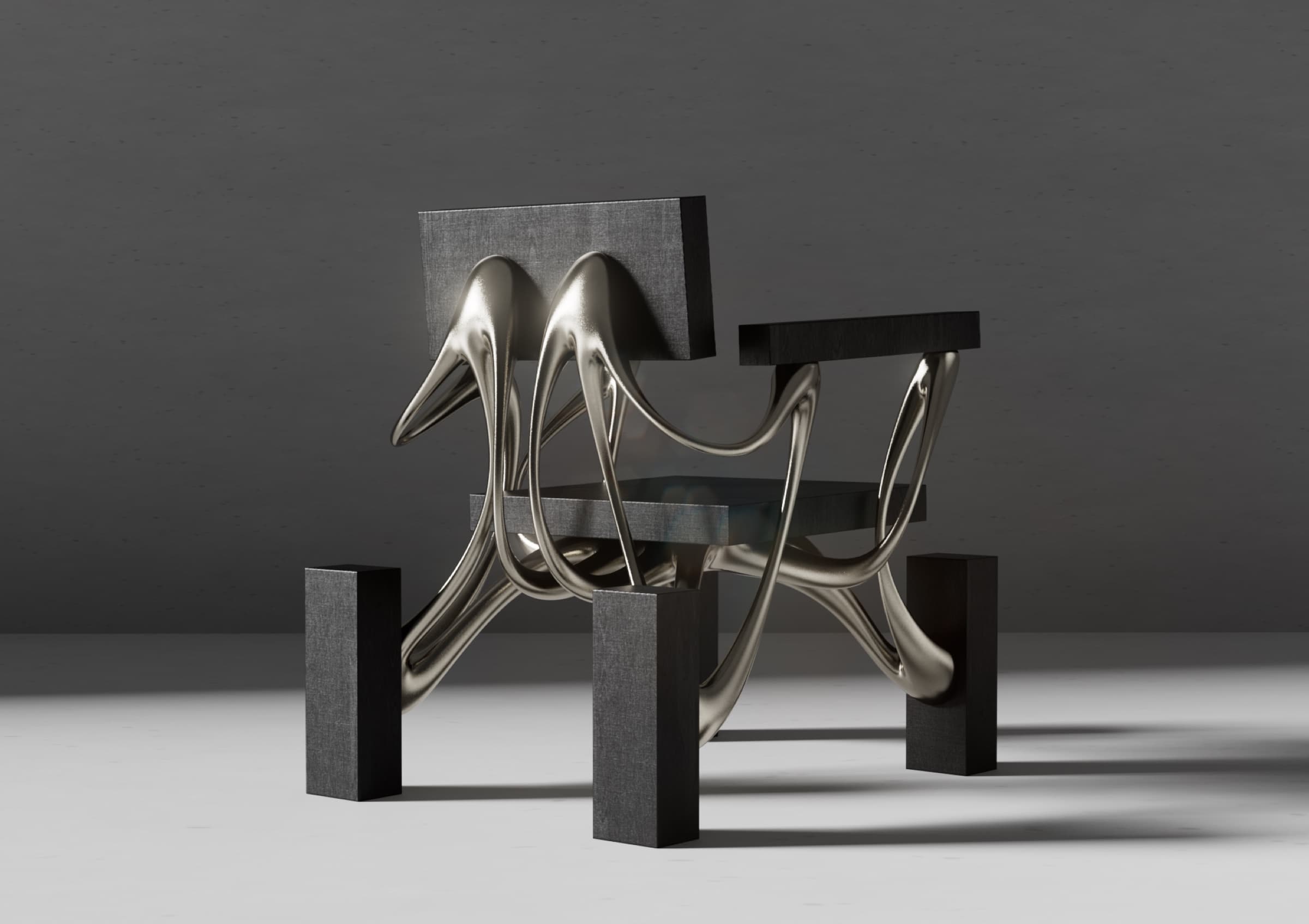
Five rectilinear oak blocks — backrest, armrest, seat, and two ground masses — charred to a matte black that swallows edge highlights.
A single cast run of nickel-silver alloy, roughly eleven metres of path length folded into half a cubic metre of chair.
The seat plate floats on the vein with no mechanical fixing to the ground masses; compression alone holds the sitting surface in plane.
Oak volumes flame-charred, brushed, and sealed with oil; the surface is carbon, not stain.
The vein grown as a constrained shortest-path solution across all load cases, then hand-edited where the solver's route crowded the sitter.
Single investment cast of the complete vein, poured around temporary armatures that position the oak volumes during cooling.